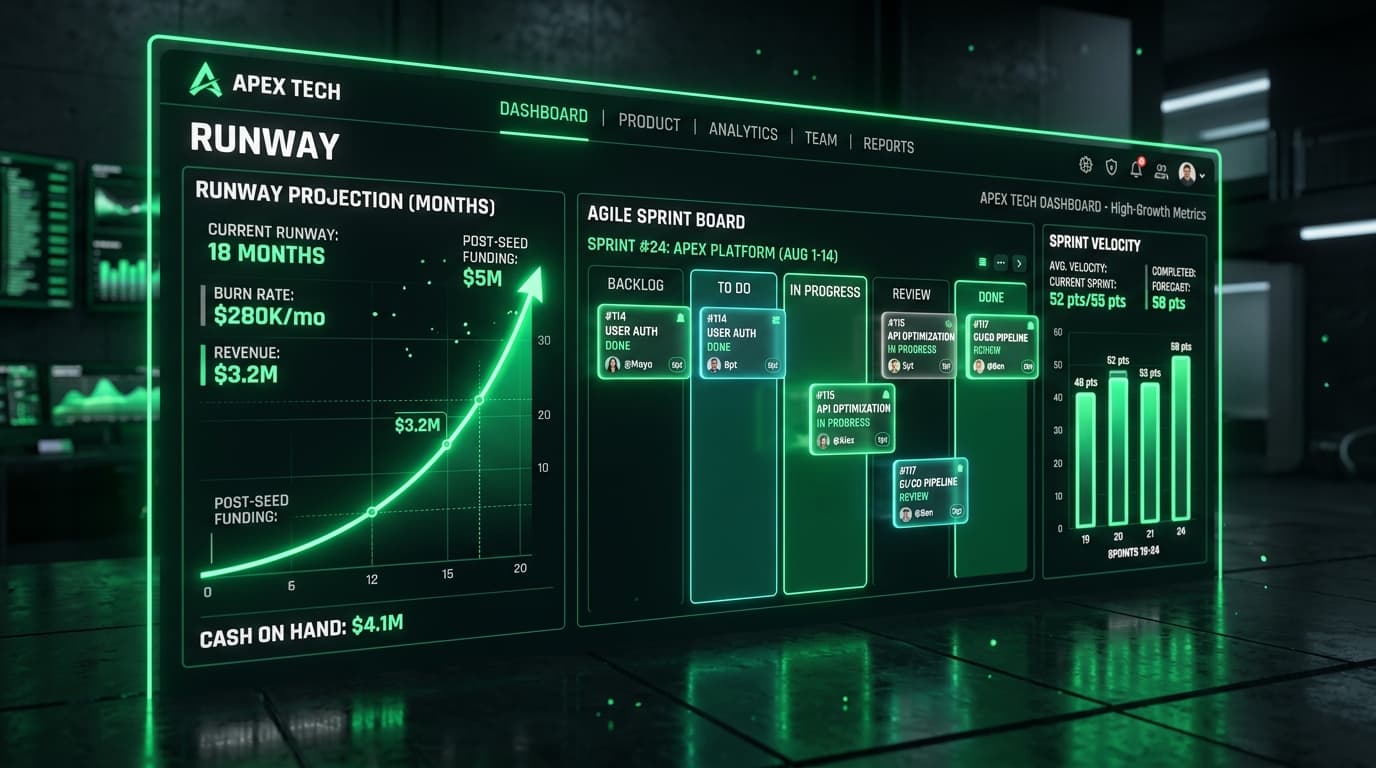
The Startup Runway Equation
Most founders obsess over their monthly financial burn rate: server bills, office rent, and SaaS subscriptions. Yet payroll accounts for 70% to 85% of total startup expenditures. If you are not measuring how engineering and go-to-market hours are allocated, you have zero visibility into your real burn efficiency.
With TrackLabs for Startups, founding teams track project allocation in real time, ensuring capital is invested into high-impact growth initiatives.
average annual R&D tax credit cash refund unlocked by early-stage tech startups.
average runway extension gained by identifying and cutting unproductive sprint churn.
of startup engineering capacity is lost to unbudgeted bugs and reactive firefighting.
1. Auditing Engineering Time: Features vs. Debt
In fast-moving codebases, technical debt accumulates rapidly. Founders often wonder why feature delivery slows to a crawl after month six.
TrackLabs visualizes where developer hours are actually invested:
Core Product Innovation (Target: 60-70%)
Direct development of roadmap features that drive user activation, retention, and subscription revenue.
Bug Fixes & Maintenance (Target: 15-20%)
Resolving user-reported defects and stabilizing production infrastructure.
Unplanned Firefighting & Meetings (Target: <15%)
Reactive triage, customer escalations, and internal status check-ins.
2. Unlocking Thousands in R&D Tax Credits
Governments across the United States (IRS Section 41), the UK, Canada, and Australia offer substantial cash tax credits for startups developing novel software.
However, tax authorities require contemporaneous time-tracking records proving which developer hours were dedicated to qualified research activities. TrackLabs provides:
- Audit-Ready Timesheet Exports: Tag engineering sessions as “Qualified R&D” with one click.
- Granular Task Documentation: Itemized proof linking specific code commits and features to technical innovation.
- Instant Tax Accountant Reporting: Generate end-of-year R&D credit packages in CSV and PDF formats.
3. Avoiding the Premature Hiring Trap
When sprint deadlines slip, founders frequently assume: “We need to hire two more senior developers.”
Adding headcount adds communication overhead. Before committing to $300k+ in annual salaries, review workforce telemetry:
❌ Premature Headcount Expansion
- Hires more people to compensate for fragmented focus
- Multiplies coordination meetings and Slack channels
- Increases monthly cash burn by $25k-$35k per hire
- Dilutes equity and shrinks remaining runway
✅ Operational Optimization
- Eliminates low-value meetings to free up 10+ hours per dev
- Enforces strict WIP limits on active sprint tasks
- Maintains lean, high-velocity founding team culture
- Preserves capital to extend runway into Series A
4. Lightweight Tracking for Fast-Moving Founders
Startup teams hate bureaucracy. TrackLabs makes time logging frictionless:
- Desktop Hotkeys: Toggle timers instantly from the system menu bar.
- Browser Integration: Track time directly inside Jira, GitHub, Notion, and Linear.
- Smart Idle Detection: Never worry about leaving a timer running during impromptu whiteboard sessions.
5. Scaling Operations from Seed to Series A
Seed Stage (3-8 People)
Establish basic project time allocation and tag R&D hours for tax credit qualification.
Post-Seed (9-20 People)
Implement capacity planning dashboards to balance workloads across engineering and sales.
Series A (20+ People)
Integrate automated payroll, contractor billing, and departmental reporting for board presentations.
Extend Your Startup Runway with TrackLabs
Gain total visibility over sprint velocity, R&D tax credits, and team focus. Start your free 2-day trial today.

Specializes in distributed workforce telemetry, privacy-first employee monitoring, and labor compliance systems at TrackLabs.
Frequently Asked Questions
Ready to boost your team productivity?
Start your free 2-day trial with TrackLabs. No credit card required.
No credit card required · Setup in minutes · Cancel anytime