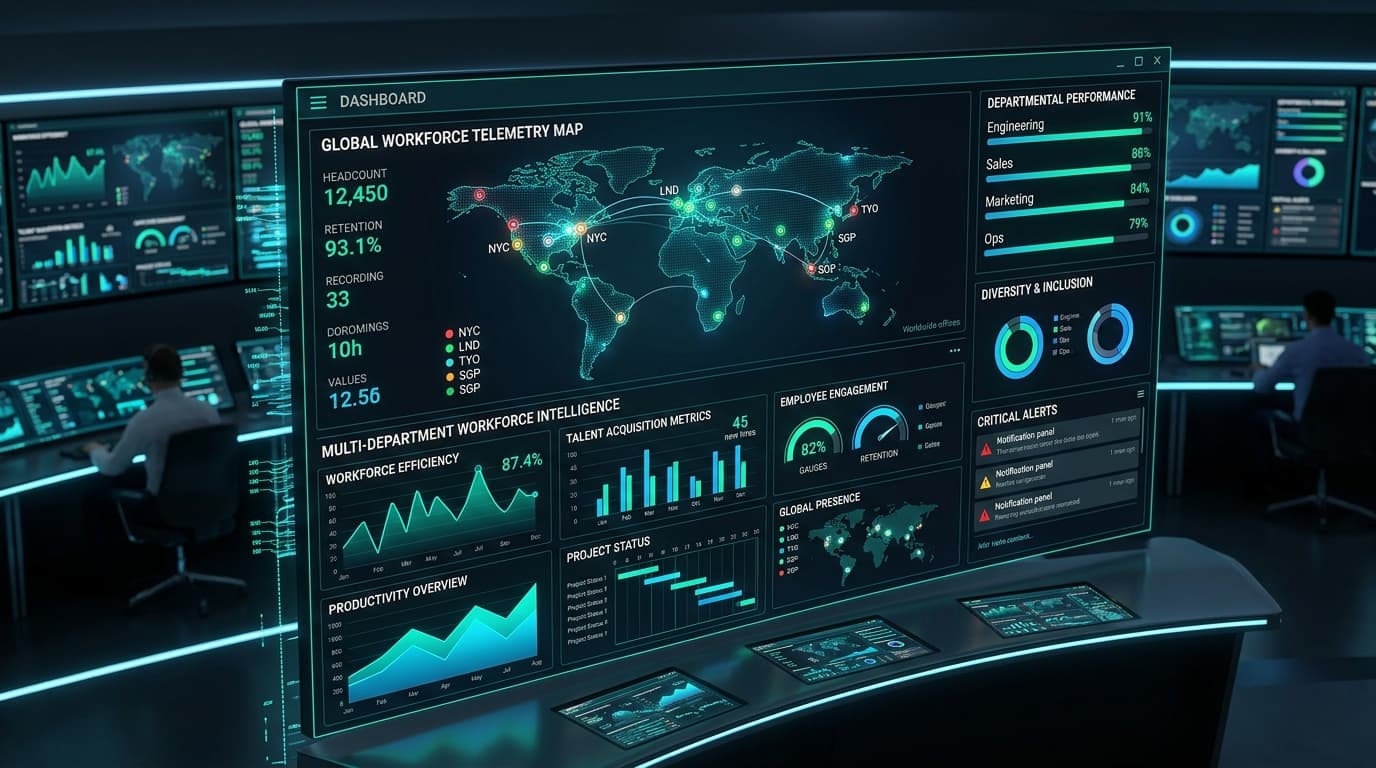
The Evolution of Workforce Analytics
Historically, enterprise productivity data was siloed inside isolated departmental tools: ticket resolution in Jira, calls in Zoom, and CRM updates in Salesforce. Executive leadership lacked a unified lens to understand how organizational time and software licenses were actually utilized.
Today, workforce analytics and reporting platforms synthesize cross-application activity into actionable, board-ready telemetry.
average reduction in enterprise SaaS software licensing costs achieved through usage auditing.
faster identification of inter-departmental operational bottlenecks and handoff delays.
centralized governance with SAML SSO, SCIM provisioning, and multi-tenant RBAC.
3 Strategic Pillars of Workforce Intelligence
Enterprise workforce analytics provides visibility across three core organizational dimensions:
1. Resource & Capacity Allocation
Balancing workloads across geographical business units, preventing regional overwork while optimizing vendor and contractor utilization.
2. Technology & SaaS Optimization
Auditing active software usage to identify underutilized enterprise licenses, redundant cloud tools, and unapproved shadow IT applications.
3. Workflow & Organizational Process Design
Measuring communication overhead, context switching, and meeting density to streamline inter-team handoffs.
1. Shadow IT Discovery & SaaS License Optimization
Enterprises waste millions annually on unassigned or abandoned software seats. Simultaneously, employees frequently adopt unsanctioned generative AI tools and cloud storage services, introducing severe security risks.
TrackLabs passive application auditing provides IT and Procurement leaders with:
- Real-Time App Utilization Scoring: Identify seats in expensive software (e.g., Salesforce, Figma, Adobe Creative Cloud) that have had zero active usage in over 45 days.
- Shadow IT Detection: Flag unauthorized web tools and unsanctioned AI services before sensitive company data is exposed.
- Subscription Consolidation: Discover redundant software purchases across separate departments (e.g., marketing using Asana while engineering uses Linear).
2. Analyzing Cross-Functional Collaboration Bottlenecks
When project deliveries stall, the breakdown almost always occurs at the handoff point between departments: product to engineering, design to frontend, or sales to customer onboarding.
With TrackLabs Enterprise Time Tracking, leaders can analyze:
❌ Siloed Enterprise Operations
- Departments operate in communication black boxes
- Handoff friction causes 3-4 week delays between teams
- Executive decisions based on subjective anecdotal claims
- Uneven workload: some teams drowning, others idle
✅ Data-Driven Coordinated Organization
- Unified visibility into cross-functional project milestones
- Automated handoff tracking reduces delivery cycle time by 40%
- Resource reallocation guided by objective capacity data
- Balanced headcount distribution across regional hubs
3. Board-Ready Operational Dashboards
C-suite executives need synthesized, high-level indicators rather than raw task logs. TrackLabs provides customizable executive dashboards displaying:
- Organizational Deep Work Index: The percentage of total company hours invested in uninterrupted execution versus collaborative meetings.
- R&D Capitalization Readiness: Real-time tracking of software engineering hours eligible for balance sheet capitalization.
- Global Headcount Utilization: Comparative efficiency and capacity across international delivery centers.
4. Enterprise Governance, SSO & Multi-Tenant RBAC
Enterprise deployments demand strict security controls:
Enterprise Governance Standards:
- SAML 2.0 & Okta Integration: Automated employee provisioning and immediate de-provisioning upon offboarding.
- Hierarchical Role Permissions: Granular access controls ensuring managers view only their direct reports while protecting organizational data.
- SOC 2 & ISO 27001 Certified Architecture: Military-grade data encryption and dedicated enterprise cloud hosting options.
5. The 90-Day Enterprise Implementation Blueprint
Days 1-30: IT Architecture & SSO Integration
Connect TrackLabs with your identity provider, establish security groups, and configure data retention rules.
Days 31-60: Departmental Pilot & Training
Roll out to pilot business units, establish custom productivity benchmarks, and train department managers.
Days 61-90: Enterprise-Wide Rollout & License Audit
Deploy to all global units, perform initial SaaS license reclamation, and present first quarterly intelligence report to leadership.
Scale Your Enterprise with Intelligent Telemetry
Gain total organizational visibility, reclaim software waste, and empower your global workforce with TrackLabs Enterprise. Schedule a consultation today.

Specializes in distributed workforce telemetry, privacy-first employee monitoring, and labor compliance systems at TrackLabs.
Frequently Asked Questions
Ready to boost your team productivity?
Start your free 2-day trial with TrackLabs. No credit card required.
No credit card required · Setup in minutes · Cancel anytime